Vanadium Oxalate: Beyond the Basics
Historical Development
Vanadium oxalate didn’t always attract much attention, despite vanadium itself surfacing in industrial use during the late nineteenth century. Metallurgists first explored vanadium compounds for steelmaking, giving rise to breakthroughs in tools and reinforcing bars. Chemists stumbled across vanadium oxalate during experiments with oxalic acid and vanadium salts. Academic curiosity pushed forward its study, fueled by the broader appeal of vanadium’s redox behavior. Papers from the 1960s capture labs trying to grow crystalline vanadium complexes—working through endless rounds of synthesis and purification. In the last few decades, especially with advances in battery and catalyst research, vanadium oxalate moved from a mere curiosity to a practical lab and industrial material.
Product Overview
Vanadium oxalate surfaces as either a blue-green or yellow powder, depending on oxidation state and purity. Specialty suppliers focus on quality for research labs, where demand may only run to grams at a time. Pricing varies enormously with vanadium market swings. Most voluminous orders relate to universities, research institutes, and custom synthesis shops. Some companies blend vanadium oxalate as a precursor in battery R&D or for thin-film catalyst preparation, seeing as it dissolves more easily than vanadium pentoxide in water and alcohols. Product is supplied in sealed HDPE or glass containers, moisture-guarded, labeled with hazard warnings and technical parameters per region.
Physical & Chemical Properties
Vanadium oxalate’s look changes with hydration and oxidation. Many see a deep green powder forming slender crystals under a microscope, ranging between 250–275°C melting points. The compound dissolves modestly in water and ethylene glycol, giving greenish-yellow solutions. Exposure to air can trigger slow color shifts, a clue to vanadium’s instability around organic acids. Technically, vanadium oxalate combines a vanadium cation (most often V(III) or V(IV)) and two oxalate anions, giving it rich coordination chemistry. The powder weighs in around 245–265 g/mol, a handy figure for researchers mapping out stoichiometry or dosing small pilot runs in new battery models.
Technical Specifications & Labeling
Manufacturers tag vanadium oxalate with purity grades, highlighting trace metals, chloride levels, and water content. Standard documentation includes batch analysis for iron, manganese, and heavy metals—common vanadium ore contaminants. Labels lean on English and pictograms for hazards, giving warnings about inhalation or accidental exposure. Scientists rely on tight specifications: even 1% impurity can throw off sensitive measurements or cell voltages. Custom research requests sometimes trigger bespoke particle size distribution or specific hydrate content. The trend over recent years points to more rigorous testing and tighter COA (certificate of analysis) standards as more industries expect traceability.
Preparation Method
Almost every published protocol starts with vanadium pentoxide and oxalic acid. Dissolving pentoxide in a dilute acid, filtering to remove insolubles, then adding a concentrated oxalic acid solution begins the process. Orange or blue-green crystals precipitate after careful evaporation and chilling, often filtered, washed, and vacuum-dried under inert gas. Some processes tweak the temperature profile or try different vanadium salts to target specific oxidation states. Many university researchers see these syntheses as a rite of passage, taking basic glassware and coaxing a stubborn solid from colored slush. Industry groups use larger reactors with agitation, monitoring pH, and filtration to control consistency for pilot-scale output—always with an eye on yield and purity.
Chemical Reactions & Modifications
Vanadium oxalate reacts vigorously with heat and certain acids, breaking down to vanadium dioxide, carbon dioxide, and oxalic acid gas. Labs use it as a mild oxidant or a feedstock to vanadium dioxide, especially for battery electrodes. Coordination chemistry opens doors: adding different ligands or reacting with bases produces mixed-oxide complexes or shifts vanadium’s oxidation state. In organic synthesis, vanadium oxalate occasionally joins as a catalyst for selective oxidation reactions. Researchers have played with ligand exchange and hydrothermal techniques, generating fine control over particle size or vanadium ion release rates, useful in both energy and environmental tech.
Synonyms & Product Names
The chemical wears several labels, including dioxalato vanadium, vanadium(III) oxalate, vanadyl oxalate, and (COO)2V. It pops up in vendor catalogs under systematic labels and trade names, often loosely translated from German, Russian, or Chinese. Database researchers sometimes face headaches sorting through misspelled or historically outdated names, a reminder of just how tangled global chemical trade can become. Product sheets usually stick to IUPAC conventions—vanadium(III) oxalate—backed up by CAS registration for less confusion in procurement.
Safety & Operational Standards
This is not a chemical for sloppy handling. Vanadium oxalate’s dust can irritate lungs and eyes; accidental ingestion or chronic exposure causes vanadium poisoning. NIOSH and European regulators rate it as hazardous. Proper PPE (personal protective equipment) includes gloves, goggles, and good ventilation or fume hoods. Material safety data sheets stress proper labeling, separated storage away from acids, and spill cleanup protocols. Disposal as hazardous waste remains the norm, and most labs train staff on how to recognize and act when symptoms—like skin irritation or respiratory distress—crop up. Even in industry, engineers check vanadium exposure in ambient air, setting tight occupational limits to avoid slow buildup in workers.
Application Area
Battery makers use vanadium oxalate as a forerunner in preparing vanadium electrolytes for redox flow batteries. This segment grows rapidly, especially with grid-scale wind and solar integration. Beyond batteries, the material shows promise in electrocatalysis and thin-film chemical vapor deposition, where vanadium’s flexibility makes it a favored candidate for smart glass and small-scale fuel cell programs. Environmental engineers explore vanadium oxalate as a component in pollutant scrubbers, tapping its redox chemistry to break down organics or heavy metals. Academic labs often pick this compound for basic research, running thousands of experiments on its electrochemical behavior and synthetic derivatives. In my own experience, the compounds that make sense in a university beaker frequently shift industrial practice a decade down the line, with vanadium oxalate no exception.
Research & Development
Vanadium oxalate sees steady investment in R&D budgets at major energy materials centers. Teams experiment with doping the material to tweak electron transport in next-gen battery cells. Some groups push into biomedical effects, investigating whether tailored vanadium complexes hold clues for antidiabetic or anticancer compounds. The compound’s value in green chemistry draws particular focus, as researchers race to replace less stable or more toxic transition metals in catalyst platforms. Data from recent patent filings show a surge in interest from China, Germany, and the US, linking vanadium oxalate with large-format battery prototypes and pollution remediation projects.
Toxicity Research
Long-term toxicity studies highlight vanadium’s risk in low doses over time—for humans, animals, and even plants in contaminated soils. Inhalation raises risks for bronchitis, mucous inflammation, and kidney buildup. Rats exposed regularly exhibit changes in blood chemistry and organ tissue. Regulatory research teams watch vanadium exposures in industrial towns, checking on soil and water levels to prevent ecosystem and public health decline. Still, the full effects remain controversial, with calls for expanded epidemiology and regular workspace testing, especially as vanadium oxalate and relatives see rising production. My work in labs always highlighted safe protocols with transition metals—a lesson hammered in after seeing colleagues recover slowly from minor exposure events.
Future Prospects
Market analysts expect vanadium oxalate demand to climb as grid storage batteries start to outgrow lithium-based options. Chinese and US policymakers see vanadium as one lever to buffer renewable energy supply, and that ripples down to precursor compounds like vanadium oxalate. Academic curiosity, particularly in catalytic application or biomedical trial phases, points to a molecule far from exhausted in its uses. Industry conferences now devote whole tracks to metal-organic frameworks leveraging vanadium oxalate, chasing after breakthrough properties in conductivity, porosity, and environmental resilience. More investment will likely drive both supply chain security and tighter environmental rules, especially as recycling processes for vanadium-based batteries become standard. From an R&D desk or a production line, the transitions coming for vanadium oxalate tie into some of the most pressing industrial shifts of this decade.
Making Sense of Vanadium Oxalate
Vanadium oxalate doesn’t get much attention outside of chemistry labs, but its uses stretch far beyond textbooks. It sits in the shadow of better-known compounds, but many important discoveries and practical uses rely on just this sort of quiet chemical. My time working in a research facility taught me that sometimes the least flashy materials can turn out to be the secret ingredient that keeps processes moving. Vanadium oxalate, with its quirky molecular structure, is one of those under-the-radar players.
Catalysts That Power Cleaner Technology
Industries reach for vanadium oxalate because it helps speed up reactions—especially ones that take a lot of energy or have stubborn starting materials. This compound gets used in the preparation of vanadium-based catalysts, which then help break down harmful emissions or start new chains of chemical reactions in environmental and petrochemical sectors. Reducing pollution from diesel exhaust and refining crude oil both depend on vanadium-based catalysts. A few years ago, I saw a demonstration in a pollution control plant where tiny additions of vanadium oxalate sharpened the reaction, making sure fewer harmful byproducts ended up in the air. Small changes like this mean a lot once you scale up to an industrial process.
How It Shapes Advanced Materials
It’s easy to forget that specialty chemicals pave the way for advanced technologies. Vanadium oxalate finds use in the creation of vanadium oxide thin films. These films turn up in smart windows—glass that shifts its light transmission at the flick of a switch, offering both privacy and energy savings. In the hands of careful engineers, these films also end up in sensors and novel battery prototypes. In one real-life example, vanadium oxalate played a role in making flexible battery electrodes. I remember how the project team used a simple solution-based process—just dissolving, coating, and drying—to build a mostly transparent film that can bend without breaking. This sort of work brings lightweight energy storage closer to reality.
Research Uncovers New Uses
Academic labs treat vanadium oxalate like a springboard for exploration. Its distinctive chemistry unlocks new areas in inorganic and organic synthesis. Researchers manage to coax it into forming different kinds of metal complexes by swapping out one part of its molecule for another. These new compounds can absorb and emit light in unique ways or change color depending on temperature. Scientific journals from the past five years show a steady stream of papers that use vanadium oxalate as a starting material for new catalysts and magnets. It isn’t just for theory—some of these new materials promise to improve future electronics and imaging technology.
Challenges and Looking Ahead
Supply can be unpredictable, since vanadium is a specialty metal not widely distributed around the world. Keeping production safe means careful handling, as oxalate-based compounds can break down and release dangerous gases if mismanaged. Proper training and ventilation serve as primary safeguards wherever material gets weighed or mixed.
In my experience, connecting universities with manufacturers drives innovation. Chemists who share insights with firms end up finding safer and more efficient ways of handling chemicals like vanadium oxalate. When these ties strengthen, industry standards rise and new solutions follow. Researchers are looking for versions that have fewer hazards or use raw ingredients from waste. This way, the old chemistry finds new life and benefits more than just a lab shelf.
What’s in a Formula?
Plenty of people pass by the world of chemistry without a second glance, but odd-sounding names like Vanadium Oxalate can actually open up a door to the building blocks behind batteries, pigments, and even drugs. Vanadium, that blue-silver transition metal often tucked away in steel alloys, hooks up with oxalic acid to create this unique compound. It’s a partnership worth a closer look—not just for labs, but for anyone interested in chemistry’s real-world impact.
The Chemical Formula
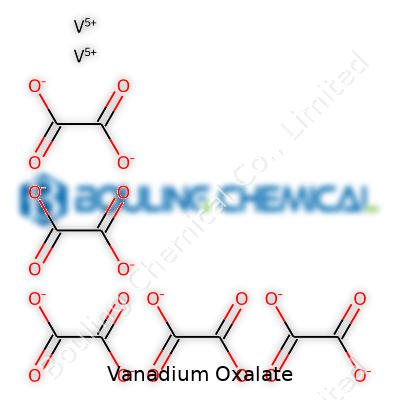
Vanadium Oxalate has the formula V(C2O4)3. Breaking this down, one vanadium atom unites with three oxalate ions. Each oxalate piece (C2O4) carries a charge of 2-, so the vanadium in this particular compound takes the 3+ oxidation state. That’s not trivial. Oxidation state affects how a chemical reacts, dissolves, and forms bonds—exactly why you’ll see vanadium oxalate mentioned in electrochemistry research or talk of metal-organic frameworks.
Worth Noting: Where It Fits in Science
Vanadium materials play a part in batteries, fuel cells, and catalysts, but vanadium oxalate itself shows up in laboratories during synthesis and crystal growth. Its ability to coordinate tightly with organic ligands lets scientists explore unusual molecule shapes and reactivity. I remember my own college days leaning over a fume hood, watching as metal ions caused bright shifts in solution color. Vanadium oxalate crystals aren’t just pretty—they hint at a whole world of chemical possibilities, especially as the push for greener industrial chemistry grows. Vanadium compounds have already found use in vanadium redox flow batteries, a promising route for large-scale renewable energy storage. The way oxalates bind vanadium affects solubility, redox behaviors, and stability.
Why It Matters for Industry and Research
Few laypeople talk about vanadium oxalate by name, but chemical manufacturing relies on silent partners like this. Labs experiment with metal oxalates to make new catalysts, study redox cycles, or create materials with precise magnetic or electrical behaviors. Getting the formula correct isn’t some academic nitpick—it means the difference between a useful product and a total flop. The ability of oxalate ions to chelate metals lets researchers fine-tune how metals deposit or dissolve, aiding fields from hydrometallurgy to environmental remediation. In the process of developing new green technologies, vanadium oxalate and similar compounds help bridge the gap between base research and large-scale application.
Challenges and Practical Paths Forward
Safety and sustainability don’t always come easy with metal-organic compounds. Vanadium, for instance, doesn’t show up as a major toxin in daily life, but vanadium dust has health risks, and improper handling of oxalates can be dangerous. Chemical producers bear responsibility to manage these risks, training workers and setting clear disposal routines. Progress often seems tied up in paperwork and compliance, but this attention to safety underpins real-world advances. On a broader scale, the future of vanadium chemistry relies on recovery and recycling from spent batteries or industrial scraps—a shift that cuts costs and lessens mining impacts.
Building on the Basics
Starting with a single formula might feel small, but each correct step in chemistry ripples forward. Vanadium oxalate illustrates how a clear understanding of composition unlocks everything from new tech to daily materials. The next time someone asks why formulas matter, Vanadium Oxalate, with its precise V(C2O4)3 structure, serves as a prime example of the backbone supporting progress in both lab and industry.
The Nature of Vanadium Oxalate
Vanadium oxalate draws attention in workplaces where precision chemistry and material science intersect. It’s a compound created by mixing vanadium—a well-known industrial metal—with oxalic acid, forming salt-like crystals that happen to be quite reactive. This substance doesn't belong in the average household, but those who work in labs, specialized manufacturing, or research centers run into chemicals like this all the time. Having spent years working alongside scientists and safety professionals, I’ve seen how quickly a routine process with vanadium compounds can turn risky if someone takes their eye off the protocols.
Health Risks Linked To Exposure
Contact with vanadium oxalate isn’t something people want to experience. Inhalation can lead to respiratory discomfort, even at low concentrations, stirring up symptoms like coughing and a sore throat quickly. Once dust reaches the lungs, vanadium’s toxicity does not take long to announce itself—sometimes showing up as headaches, dizziness, or worse, metal fume fever for those exposed regularly. Over the long haul, I’ve seen technicians report chronic effects ranging from nasal irritation to more severe respiratory issues, especially if protective gear is skipped. Skin absorption brings its own troubles, causing irritation or even burns if powder or solutions touch unprotected skin.
Environmental Concerns Linger
Vanadium oxalate’s hazards aren’t limited to human health. Mishandling or accidental spills can infiltrate water and soil, giving local organisms more trouble than many realize. The oxalate part of the molecule can disrupt aquatic environments, while vanadium persists and builds up, stressing local ecosystems. A friend in field remediation pointed out how small amounts of metal salts leaking into groundwater keep local authorities busy for months, sometimes forcing entire communities to change their water sources.
Regulatory Perspective and Industrial Duty
Governments take a strong stance against exposure to vanadium-based chemicals. Agencies like OSHA set exposure limits, reinforcing the idea that the risk isn’t hypothetical. Regulation gets real fast when handling bulk quantities or producing anything with possible trace contamination. Companies are expected to keep records, label materials, and maintain robust ventilation. There’s no room for shortcuts: proper training and ongoing supervision stay front and center in facilities that don’t want to end up dealing with injury reports or penalties.
How To Reduce The Hazards
Prevention lies in robust work practices backed by solid personal protective equipment. Labs or plants store vanadium oxalate in airtight containers, away from any unnecessary heat, moisture, or sources of contamination. Respiratory protection isn’t optional when handling powder form, and full skin coverage blocks accidental contact. My experience shows that emergency eyewashes and showers, stationed right at the entrances and exits, make a big difference—especially on days when mistakes catch even the most seasoned workers off guard.
Clean-up protocols must be sharp—dust and residues swept or vacuumed with specialized equipment, never just brushed into a bin. Training sessions help keep everyone updated, reminding staff why it’s safer to overreact than to get complacent around compounds with unpredictable toxicity. Engineering controls, like fume hoods and closed systems, should form the backbone of facility design.
The Bottom Line
Working safely with vanadium oxalate means respecting its hazards every single day. Reliable information, effective controls, and a culture of vigilance bring risks under control. Ignoring warning signs or relaxing standards doesn’t end with just a slap on the wrist; it can lead to lasting damage to people and the local environment.
Why Careful Storage Matters
Vanadium oxalate looks harmless at first glance—just another chemical compound sitting on a shelf in a lab or in an industrial supply room. This stuff, though, packs some real risks you don’t want to underestimate. I remember my early days in a research lab, where enthusiasm sometimes outpaced good judgment. A dusty beaker, a bag of powders, a dash of neglect—mix-ups happen fast. Vanadium oxalate deserves more respect because the way you handle and store it can mean the difference between a safe environment and a health hazard.
What You’re Dealing With
The pale color doesn’t scream danger, but vanadium compounds can slip past the unwary. The oxalate part adds another layer of challenge. Both parts of this compound are toxic if inhaled, ingested, or spilled onto skin. Breathing in oxalate dust or getting vanadium on your hands creates chemical exposure you don’t need. OSHA flags vanadium compounds as irritants and potential health risks, not just to workers but also to anyone in the vicinity if things go wrong.
Sensible Steps for Storage
Good storage doesn’t start with fancy equipment. It starts with clear labeling and a dedicated, well-marked area far from food, drink, or personal items. I make a habit of writing the full name, the date received, and any special warnings directly onto each container. Shelving needs strength and stability, and I never stack jars high; one tumble spells trouble.
Keeping vanadium oxalate in a tightly sealed, corrosion-resistant container cuts down on spills and exposures. My old mentor drilled into me the need for glass or certain types of plastic—metal reacts and can cause leaks, especially if some moisture creeps in. A dry environment matters more than people realize. Humidity can trigger unwanted reactions, and a humid storeroom turns risk into reality. It helps to store desiccant packs alongside the compound to keep things dry.
Temperature and Ventilation—Non-Negotiable
Some chemicals forgive a little heat or cold—vanadium oxalate isn’t one of them. Excess warmth speeds up decomposition and increases toxic fume release. I stick with room temperature storage, out of direct sunlight, and away from heat sources. Decent ventilation isn’t a bonus—it’s a bare minimum. Chemical vapors build up quickly, and a stuffy storage space can hit you before you even realize it.
If you’re working in a basement or an old building, don’t trust old assumptions. Set up a small exhaust fan or transfer sensitive materials to a chemical storage cabinet with built-in ventilation. I’ve seen labs skip this step and pay for it later with avoidable exposure incidents.
Segregation and Emergency Planning
Never store vanadium oxalate with acids, peroxides, or flammable materials. Cross-reactions can produce toxic gases or trigger a fire. I use color-coded shelves to keep things simple.
Spill kits and goggles hang by the door in case things go sideways. Everyone in the workspace learns where to find them on the first day—not after a mess appears. Lab safety drills might feel repetitive, but they make a real difference when someone’s hand slips or a bottle breaks.
Responsibility Doesn't End With Storage
Storing vanadium oxalate with care protects people and the environment from harm. My lived experience, and plenty of accident reports, show that cutting corners or getting lazy with hazardous chemicals leads to bigger problems. If you’re part of a team, make storage protocols a team priority. Share knowledge, stay alert, and treat every container like your own safety depends on it—because it does.
Solid Structure and Appearance
Vanadium oxalate usually forms as a deep green or blue-green crystalline powder. If you’ve ever handled oxalates in a lab, you know they often have a distinct look and feel—some will clump, others will scatter easily. Vanadium oxalate tends to absorb moisture, so it gets sticky if left outside too long. Keep it sealed to keep that classic crystalline form.
With its sharp hues, this compound is easy to spot on a shelf lined with glass jars. You won’t find it breaking apart or dulling without some help from water or air, because it stays pretty stable under most basic storage conditions.
Solubility and Water Interactions
Water is a game changer with vanadium oxalate. Drop some crystals in a beaker of water and you’ll watch them dissolve steadily, releasing vanadyl ions and oxalate ions. Solubility varies depending on the temperature, but room temperature water gets the job done. In stronger acids, that process speeds up, breaking bonds quicker than in plain tap water. If you try the same in organic solvents—like ethanol or acetone—it won’t budge much. Those crystals stubbornly hold their shape, showing just how selective their interactions can be.
Anyone who has worked with oxalates knows safety comes first. Vanadium and oxalate ions by themselves both need careful handling, and together they call for gloves and fume hoods. That’s not just lab paranoia—these aren’t materials you want absorbing through your skin or floating around in the air.
Thermal Properties
Heat a sample of vanadium oxalate, and you see some real action. Heating past 100°C, water of hydration escapes—usually you’ll hear a faint hiss, as the powder loses weight and texture. Push temperatures higher, and the oxalate falls apart, breaking into vanadium oxide, carbon monoxide, and carbon dioxide. In college labs, anyone burning oxalate salts learned to vent the room—carbon monoxide is no joke, and these reactions move quickly once started.
Vanadium oxalate breaks down before reaching its melting point, so you won’t find pools of molten material. The color often changes as it decomposes, signaling those structural changes to vanadium’s coordination environment.
Magnetic and Electrical Traits
Vanadium brings magnetism to the table, especially in oxalate complexes. Most vanadium oxalates show paramagnetic properties, often because vanadium sits in the +4 oxidation state. Tested with a basic magnet, small samples can show a weak response. In larger industrial labs, these traits get measured with precise tools, providing clues about the structure and chemical environment.
As for electrical conductivity, like most metal-organic salts, vanadium oxalate does not conduct electricity in solid form. Once you dissolve it in water, ions begin to move, giving the solution mild conductive properties—enough for analytical measurements, but nowhere near a metal wire.
Why These Properties Matter
Understanding physical traits goes beyond curiosity. These qualities define how vanadium oxalate fits into batteries, catalysis, and material synthesis. Solubility, color, stability, and breakdown pathways all connect back to making safe, effective, and reliable applications. Anyone planning to use this compound needs reliable data, trustworthy techniques, and a respect for the real risks involved—because laboratory mishaps, even with a simple green powder, leave marks that last much longer than any experiment.