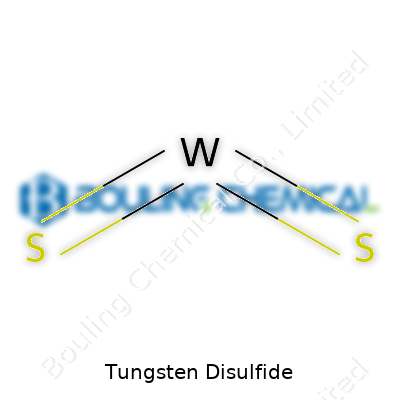
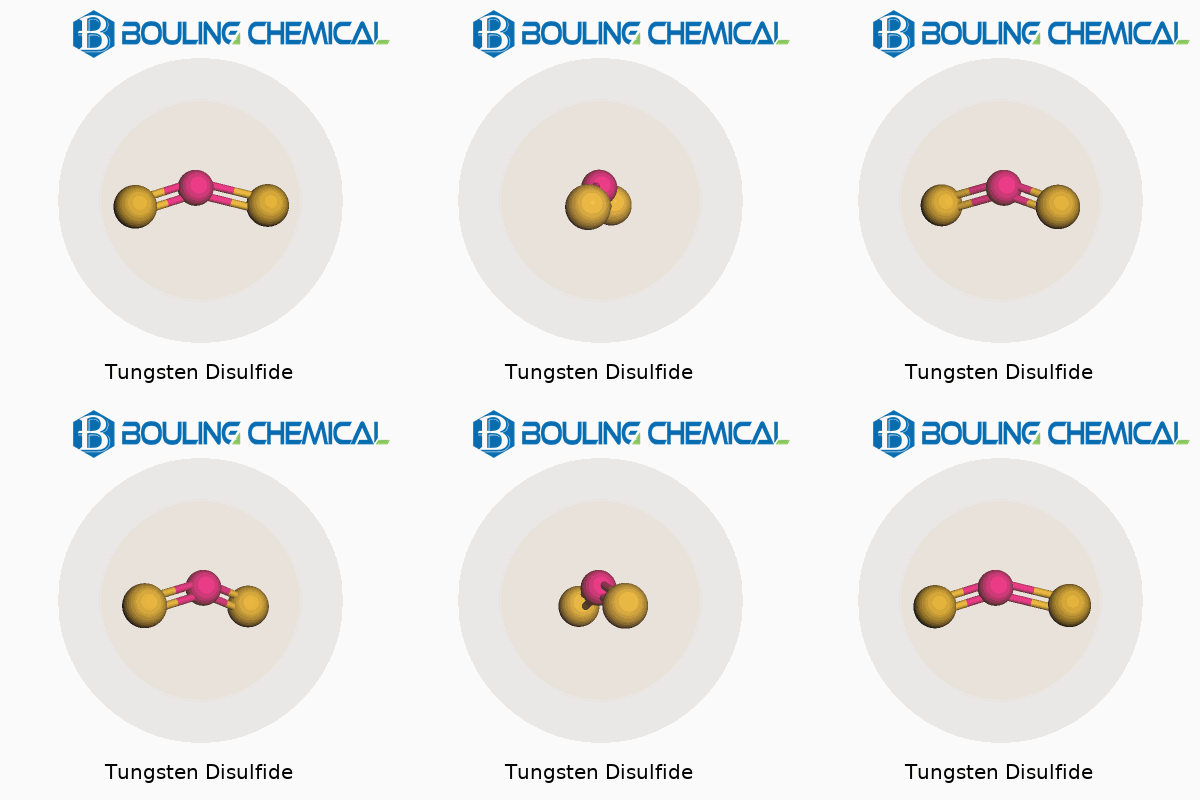
Tungsten Disulfide: Beyond the Lubricant Hype
Historical Threads: From Curiosity to Industry Workhorse
Tungsten disulfide's journey goes back to early 20th-century labs when scientists searched for durable lubricants. Back then, tungsten compounds rarely made headlines outside of filament research. Once WS2 slid onto the scene, its slick, almost frictionless properties intrigued anyone tinkering with engineering challenges. Military and aerospace engineers started using it in extreme environments—high altitude, deep vacuum—where greases failed. By the seventies, WS2 powders quietly kept satellites spinning smoothly and bearings from seizing, well before synthetic alternatives could compete. Yet, despite this pivotal background, tungsten disulfide rarely features in classrooms or news articles, probably because much of its value has played out behind closed doors in reliable, unsung industrial roles.
Product Overview: More Than Just a Powder
Tungsten disulfide usually arrives as a fine, dark-gray powder. What makes it stand out? Its lamellar structure creates almost negligible friction, which makes components last far longer under heavy loads. In manufacturing, folks rub it onto gears, metal dies, and threads to keep machines running even with minimal oil. Some suppliers press WS2 into aerosol sprays or pastes—easy to tote, quick to apply, which suits shop floors or space stations. Once inside a mechanism, it coats surfaces with a slick, nearly indestructible barrier that's much thinner and more reliable than traditional options.
Physical and Chemical Details: Unique Structure, Surprising Stability
WS2 powders draw their edge from a hexagonal crystalline structure—think of it as countless flat sheets, each sliding across the next with almost no resistance. Compared with common molybdenum disulfide, WS2 holds out longer against oxidation, withstanding temperatures up to 650°C in air and even 1,300°C in dry atmospheres before break-down. Not every material keeps its cool like this. It barely dissolves in water or acids, which makes disposal and cleanup straightforward but raises questions about long-term persistence in waste streams. Little electrical conductivity yet standout chemical resilience gives it a spot in specialized electronics, not just in gears and pistons.
Technical Specifications: What Labels Actually Tell You
Commercial tungsten disulfide rarely arrives as pure as lab samples. Pure WS2 clocks in at a molecular weight of about 247.97, bulk density near 3.75–4.75 g/cm³, and particle sizes ranging from several microns down to nanoscale powders used in R&D. Labels should mention purity—80% WS2 signals fillers, while over 99% brings in real value for research and critical applications. Particle size makes all the difference, as smaller grains slip into tighter spots, boosting lubrication or catalysis. Technical sheets deserve more than a glance—their claims about thermal stability, water content, and trace elements affect how you work with the stuff in real-life projects.
Preparation Methods: Getting to the Good Stuff
Turning tungsten and sulfur into a stable, useful powder takes more than tossing them together and hoping for the best. Chemical vapor deposition stands out as a precise, scalable method—gaseous tungsten compounds meet a sulfur source under controlled heat, leaving behind those slippery WS2 layers. High-temperature sulfurization—heating tungsten at 600–800°C under a sulfur atmosphere—also gives reliable results for bulk production. People looking for even finer particles go for hydrothermal or solvothermal synthesis, which coax nanostructures out of solution at lower temperatures. I've run across folks in research who tweak everything from solvent type to reaction time to nudge shock-resistant or extra-durable nanostructures into existence. Each method brings trade-offs in cost, yield, and environmental impact.
Chemical Reactions and Modifications: Not Just a Static Coating
WS2 doesn’t just sit still—it interacts with metals and other chemicals in subtle ways. Exposed to strong oxidizers or hot air, the layers can lose sulfur, turning into tungsten trioxide and releasing SO2. On the flipside, careful doping with elements like selenium or phosphorus alters the band structure, creating materials for sensors or solar cells. Milling WS2 with graphite, for example, builds hybrid lubricants that outperform either one alone. Nanoscale engineering makes the material more than a simple powder, and ongoing research into chemical modifications unlocks fresh uses in detergents, hydrogen storage, and electronics. Each tweak brings new handling and safety issues, showing how chemistry and engineering constantly cross paths in practical work.
Synonyms and Product Names: Keeping Track of Identity
Tungsten disulfide rolls under a stack of names in catalogs and technical papers. Common abbreviations include WS2, tungsten(IV) sulfide, and di-tungsten tetrasulfide, though those rarely pop up outside textbook glossaries. Trade names sometimes pop up—Lubrimet, Tungstenite, even proprietary blends touting “nano” upgrades. Some companies remix the recipe with binders and marketing spin, but the real work always comes from the same slippery WS2 base. Sorting through these names—especially between bulk industrial and nanomaterial forms—takes patience and some experience with catalog codes and cross-references.
Safety and Operational Standards: More Than Just Gloves and Masks
Working with tungsten disulfide doesn't bring the sort of dramatic hazards you’d find with volatile solvents or heavy metals, but keeping dust out of airways matters. Powders—especially nano grades—drift around easily and, once airborne, will head straight for the lungs. Basic PPE, ventilation, and careful cleaning matter on shop floors just as much as in research labs. Material safety data sheets stress avoiding inhalation and minimizing skin contact, and good practice means disposing of surplus WS2 as non-hazardous solid waste, unless it’s mixed with other chemicals. While heavy, cumulative metal exposure hasn’t triggered major health scares, evidence keeps evolving, so most responsible workplaces treat it with healthy respect.
Application Areas: Where It Earns Its Keep
Aerospace and defense engineers have long relied on tungsten disulfide in harsh, high-friction environments—bearings, ball screws, and gear systems that can’t risk seizing in the field. Motorsports mechanics apply it straight onto race car engines and transmissions for last-mile protection during breakdowns on the track. Heavy industry uses it in metal forming, fastener assembly, and injection molding, where downtime costs pile up fast. In electronics, WS2 thin films shape transistors and photodetectors for next-gen flexible circuits. We’re also seeing WS2 nanostructures become research darlings for hydrogen evolution reactions (HER) and lithium battery electrodes, showing how this once “boring” powder shapes big leaps in green tech.
Research & Development: The Push into the Nano World
A decade ago, few folks outside engineering circles paid much attention to tungsten disulfide. Plenty changed after WS2 nanosheets and nanotubes surfaced in journals, promising leaps in supercapacitors, batteries, and even quantum electronics. Condensed matter labs race to explore WS2 as a semiconductor for field-effect transistors, rivaling the buzz around graphene. Biomedical researchers try loading drugs onto WS2 nanoparticles for targeted delivery, hoping the chemistry keeps payloads stable until they’re needed. The field moves quickly—searches for patent filings and published data surge every year, and partnerships between materials firms and universities grow thicker, all banking on WS2 to break technical barriers.
Toxicity Research: Navigating Unseen Risks
Despite its apparent chemical stability, the fine particles of WS2, especially at the nanoscale, bring up important health questions. Animal studies suggest low acute toxicity, with much of the material passing through bodies without dramatic biological damage. Still, inhaled fine dusts can cause lung irritation, and the long-term fate of nanoscale WS2 inside living tissues isn’t crystal clear. Environmental persistence worries scientists: non-reactive particles may accumulate in soils or waterways, and breakdown products may interact with microorganisms in subtle ways. Regulatory agencies keep tabs on new findings, and industry usually takes a precautionary stance— especially with nano-WS2 meant for medical or environmental uses.
Future Prospects: Where WS2 Could Go Next
Tungsten disulfide no longer sits quietly as an unglamorous lubricant. Venture capital and government research both invest in new applications, hoping WS2 will push breakthroughs in everything from flexible electronics to lighter, longer-lasting batteries. Energy storage relies on materials that can endure thousands of charge cycles without breaking down, and chemists tap WS2 plates for exactly that promise. The buzz around hydrogen as an energy carrier puts tungsten disulfide in the crosshairs for catalytic membranes and electrodes. Engineers chase ways to scale up pure, defect-free WS2 sheets while controlling cost and environmental side effects. Education and clear labeling will help users get the most from this old-yet-new material, keeping its promise alive in both heavy industry and cutting-edge science.
The Power Behind WS2’s Slippery Nature
Growing up in a family of mechanics, I learned quickly that a stubborn bolt could ruin a perfectly good afternoon. The lesson stuck with me—sometimes, reducing friction is the difference between a stalled project and a job well done. Tungsten disulfide, often labeled as WS2, enters the picture exactly here. This material does not carry the reputation of Teflon or graphite among the general public, but inside industrial workshops, aeronautics labs, and research facilities, it has quietly made a big impact.
Solving Friction Problems Where Oil Fails
In heavy machinery, heat builds up fast. Traditional lubricants break down under severe conditions or in environments where dust, dirt, or high loads dominate. Tungsten disulfide steps in as a solid lubricant that shrugs off the heat and resists chemical breakdown. Its layered crystal structure lets it slide easily, protecting metal parts in turbines, spacecraft engines, and car drive shafts. I’ve watched seasoned engineers reach for a canister of WS2 powder to prep a gear assembly headed for a desert environment. The decision always pays off long after the oil would have burned away or thickened.
Protecting Tools and Extending Machine Life
The cost of downtime in a manufacturing plant piles up quickly. Tungsten disulfide-coated parts often last longer—many times outlasting those running with basic oils or greases. In precision work where tolerances are tight, like medical equipment or semiconductor fab lines, even a little extra wear shortens a tool’s useful lifespan. WS2 coatings act as a barrier against both abrasion and chemical attack. That means more time making chips and less time swapping out spent parts. Companies aiming to stretch maintenance dollars keep coming back to WS2 for precisely this reason.
Lightening the Load in New Technologies
Electric vehicles call for quieter, lighter, and more efficient systems. Every new motor or reduction gear seems to chase those goals. Engineers add tungsten disulfide as a dry lubricant or blend it into greases to trim away parasitic losses. The result is less energy wasted on useless heat or squeaks. In aerospace, designers love anything that lowers friction without adding weight or risking contamination. NASA’s own Mars rovers count on WS2 coatings to help mechanical joints endure years of abuse far from an oil can.
Challenges and Real-World Fixes
Tungsten disulfide’s primary hurdle remains in cost and handling. High purity grades demand careful production, and application requires training to avoid health risks associated with airborne powders. Watching a colleague suit up in a respirator brings home the reality: safety isn’t just a checklist, it’s a workplace culture. Regular training, proper ventilation, and investing in safer forms like pre-applied sprays help address this. On the financial front, companies often balk at the upfront cost. Still, spreadsheet after spreadsheet shows the payoff through fewer breakdowns and longer intervals between rebuilds.
Looking Ahead
As the push for more sustainable engineering grows stronger, materials like tungsten disulfide gain attention. Fewer lubricants going to waste, less downtime, more power converted to useful work—all add up to real gains. If the tools in your life face enough punishment to burn through most ordinary lubricants, it’s worth considering what this compound has quietly done across industries where failure just can’t be an option.
Why Tungsten Disulfide Matters in Mechanical Life
Running any kind of machine often comes down to keeping moving parts from grinding themselves to pieces. As someone who's spent hours with busted lawnmowers and creaky gears, I know the struggle of friction. Mechanics, engineers, cyclists—anyone who works with metal parts—knows that finding the right lubricant can mean the difference between smooth motion and an expensive repair bill. Tungsten disulfide (WS2) has earned a reputation as a tough contender for some of the harshest conditions in industry.
The Slipperiness Factor
Tungsten disulfide is downright slick. Its molecular structure, shaped like stacked sheets, gives it one of the lowest known coefficients of friction, just barely above 0.03. To put that in perspective, dry steel-on-steel contact sits above 0.5. Slather it on bearings, gears, or sliding metal parts, and you’ll notice instantly less drag. Unlike traditional oils or greases that can gum up with dust, WS2 holds up in all sorts of environments, from arctic chill to burning heat.
Durability Through Grit and Grime
Anyone working on heavy machinery will run into dirt, grit, and moisture. Many lubricants break down or get washed out over time. Tungsten disulfide doesn’t quit so fast. Its particles can withstand temperatures pushing above 500°C and still keep rolling. On top of that, it stands strong against corrosive chemicals, so you won’t see the kind of rust or wear that creeps up with regular greases. Tests by NASA and other research outfits back this up, showing that WS2 coatings often outlast other lubricants in both space and terrestrial hardware.
Environmental Angle and Health Notes
There’s growing scrutiny over what goes into lubricants, and how they affect people and our surroundings. WS2 itself doesn’t degrade into toxic byproducts. It doesn’t wash away with the next rainstorm like some graphite blends do. Maintenance workers and assembly line techs don’t have to worry about fumes like they would with certain oils. This makes it appealing for industries looking to comply with environmental standards or just cut down on health complaints from the crew.
Practical Challenges and Real Use
Tungsten disulfide doesn’t handle everything right out of the jar. Its fine powder can clump or float off in the wrong spots if not applied well. Spraying or rubbing it in usually gives the best results, often after a careful cleaning routine. Folks in the field sometimes talk about the extra time it takes to prep parts and get the powder evenly set, especially compared to squirting a tube of grease. It costs more than standard oils too, so budget-conscious garages might save it for critical jobs—think aerospace, race engines, robotics, or places where failure isn’t an option.
Possible Ways Forward
As manufacturing keeps getting faster and gearboxes shrink, the need for better lubricants keeps growing. Research still explores how to pair tungsten disulfide with other additives, or blend it into longer-life coatings, to stretch its performance without driving up expenses. Workshops can work with suppliers to test new forms—like sprays, polymer mixes, or embedded coatings—before rolling them out wide. What’s clear already: tungsten disulfide isn’t just talk, it’s the reliable friend machines call on when things get tough.
Putting WS2 Under the Microscope
In the world of industry and engineering, Tungsten Disulfide (WS2) has carved out a niche. It slides into all sorts of products, from aerospace lubricants to CNC machining, thanks to its low friction and reliable performance under high heat. The question that always lingers: is this gray-black powder safe to touch, breathe around, or store at home or in the shop?
Comparing Tungsten Disulfide to Old-School Alternatives
Years ago, I worked in a small machine shop that depended on molybdenum disulfide and graphite powders. Good luck keeping those off your skin or out of your lungs. Wet towels often turned black in minutes; noses got tickled by stray dust. Tungsten Disulfide acts much the same—fine powder, eager to cling to fingers, sleeves, and sometimes the air if poured without care. Unlike asbestos, lead, or mercury, WS2 does not break down to release fibers or vapors dangerous at the drop of a hat. Thanks to its chemical stability, it’s not likely to react or fall apart under ordinary conditions.
Is It Really Safe?
Looking at what scientists and regulators say, the answer leans towards yes. Bulk Tungsten Disulfide has low solubility in water and barely budges in most solvents. That sounds promising if you worry about skin contact or spills. The Environmental Protection Agency and the European Chemicals Agency do not list it under high-concern materials. Most published research shows limited toxicity and no direct evidence of cancer or dramatic health fallout, at least in forms handled within factories.
Toxicity always depends on dose and route. Eating a spoonful—obviously a terrible idea with any industrial powder—could upset your stomach or cause other problems, purely based on its bulk. Inhaling fine particles over months or years, especially during production or grinding, creates a real risk for lung troubles or irritation. Most machining shops use gloves, dust masks, and sealed containers, not because this powder is deadly, but to respect common sense and OSHA guidelines. Those precautions also handle the general problem of dust in the air, which is never good for lungs or long-term health.
Nanoparticles and New Risks
Nanotechnology throws a new twist. Labs today make WS2 down to single-layer sheets. At that size, more surface area might trigger unusual effects in the body if breathing occurs. Most of us don't encounter nanoparticle WS2 unless working in research or manufacturing cleanrooms. Early studies hint at possible lung inflammation from ultrafine WS2, but researchers say these results aren’t strong enough to sound alarms—at least not yet. More studies will surely shape how companies handle nanomaterials down the line.
Simple Steps for Safer Handling
Anyone using Tungsten Disulfide at work or home should treat it with the same respect as other powdered materials. Gloves prevent skin contact. Dust masks or basic respirators cut out the risk of breathing particles. Cleaning up spills with damp cloths—not dry sweeping—keeps bits out of the air. Storing containers closed keeps curious kids or pets safe. As with other shop chemicals, label everything and keep Material Safety Data Sheets (MSDS) handy.
Tungsten Disulfide’s track record so far brings no horror stories. Still, what keeps everyone safe is not an official promise from regulators, but steady habits that carry over from handling any unfamiliar powder—caution, common sense, and a healthy dose of respect.
Looking Beyond Surface-Level Comparisons
Some engineers swear by molybdenum disulfide, claiming it’s lasted years in industrial settings where regular greases gave up in months. Others point to tungsten disulfide for its performance in punishing extremes. Both compounds show up in gearboxes, spacecraft, and even mountain bikes, but their differences matter when the pressure climbs or when smooth running isn’t just nice—it’s essential.
Getting to Grips With What Sets Them Apart
WS2 and MoS2 both belong to the group known as transition metal dichalcogenides. They both show up as fine, gray-black powders, soft to the touch, with a feel like graphite. Each of them forms layers that slip past each other and help fight friction between metal surfaces—a little like Teflon, but in powder form. Some mechanics use MoS2 in everything from engine oil to dry film coatings for moving parts. I’ve noticed machines run quieter and require fewer maintenance shutdowns with this addition in heavy industry.
Tungsten disulfide’s claim to fame comes from its ability to handle even more heat and pressure. Its melting point sits above 1,250°C, well above MoS2’s range. Dive into a place with brutal mechanical stress or frequent temperature spikes—airplane engines, injection molding machines, or inside a racing gearbox—and WS2 usually sticks around longer. Even in Aerospace, where engineers obsess over every ounce and degree, tungsten’s resilience under load wins it a place.
Why Industry Chooses One Over the Other
Cost guides plenty of decisions, and here molybdenum disulfide comes out ahead. MoS2 is cheaper, widely available, and works for most applications just as well as tungsten-based options. For daily-use vehicles, typical factory robots, or conveyor systems running at room temperature, the benefits of WS2 don’t always justify spending more. I’ve seen shops stick with moly for decades, with little downside.
Tungsten’s premium price tag makes sense where downtime eats up thousands per hour or where harsh grind wears failures into parts. Manufacturers step up to WS2 for extended tool life in metal forming or when retrofitting legacy equipment for higher loads. Military and aerospace specs often call for tungsten disulfide in critical spots—a landing gear in freezing wind, antennas swinging through desert sandstorms, sensors on Mars rovers.
Environmental and Health Considerations
Some folks worry about environmental impact every time a new material comes on the scene. Neither compound breaks down quickly, but studies point to both being less toxic than older lead-based lubricants. Still, best practice means using gloves and catching dust in ventilated setups. Many industries seek suppliers with clean mining and processing standards, and improvements keep coming. More research could pin down exact risks, but for now, both options seem safer than many traditional alternatives.
Where Things Could Head Next
Research labs keep finding ways to shrink these compounds into nanoparticles. As coatings, these tiny versions drop the friction even more and fill microscopic surface cracks better. Engineers play with blends—throwing in WS2 for high heat, but saving costs by sticking with MoS2 elsewhere. As electric motors spread and wind turbines get larger, both lubricants are showing up in new places. Meanwhile, more recycling and stricter sourcing standards could cut environmental worries down the line.
People rely on the right tool for the job. Molybdenum disulfide works for most, and tungsten disulfide pulls ahead where the stakes are high. The choice shapes how machines run, how long they last, and the footprint they leave behind.
The Down-and-Dirty on High-Performance Lubrication
Sliding parts under harsh conditions run into a lot of trouble. Sticking, wear, and heat build-up can bring the toughest machinery to a stop. Tungsten disulfide (WS2) steps in with an answer that often surprises even seasoned engineers: serious performance across a range of punishing temperatures.
If you’ve ever tried to keep a motor, gearbox, or printer head happy in the heat, you’ve probably wondered about finding a lubricant that doesn’t just burn off or seize up. Grease melts. Oil sprays out. Additives can leave residues or form crusts. Tungsten disulfide takes a different path, thanks to its crystal structure and chemical stability.
The Numbers Behind the Promise
You’ll often hear that WS2 stays reliable between minus 270°C and roughly 650°C in vacuum, or about 450°C when exposed to the open air. That means it survives far colder than Antarctica’s worst, and shrugs off temperatures that make steel glow deep red.
On the lower end, cold starts in aerospace, satellites, or deep space science instruments depend on the dry, slippery nature of WS2—it keeps moving parts gliding even close to absolute zero. Ordinary greases turn solid and stiff. Tungsten disulfide remains slick, because no oils or binders freeze up.
Move to the upper end, and this compound outlasts traditional molybdenum disulfide by at least 100 degrees. Above 400°C, many greases and solid lubricants start breaking down or forming unwanted oxides. Tungsten disulfide proves stubborn, only forming oxides and losing its layered slipperiness above 450°C in air or 650°C in vacuum. That reflects a fact proven in aerospace and high-temperature industry: moving parts stay alive longer, with less rebuilding and downtime.
Why Tempt Fate with Anything Else?
Decision-makers in the field —from automotive design to critical defense satellites— trust WS2 because it lasts where others fail. My experience with automotive rebuilds and custom fabrication has taught me one hard lesson: downtime costs money, sometimes a lot more than just the next bottle of oil or tub of grease. Old-school graphite burns up, oils turn to smoke, but WS2 keeps sliding until the metal itself gives out. This has mattered most for racing engines under wild thermal swings, and for scientific equipment that needs to survive repeated heating and cooling.
Down-to-Earth Solutions for Stubborn Problems
The right answer isn’t always found in a catalog. Sometimes, a tech will test different lubricants side by side on a shop floor, metal parts chattering next to each other. Over time, one fact becomes clear: if environmental extremes are part of the equation, WS2 sets the bar. Its temperature range saves both parts and patience.
Manufacturers still argue over price points and application methods, but for high-value equipment —think jet turbines, ball screws in CNC machines, or sealed bearings in satellites— this material’s broad temperature window is worth it. Simple comparisons to molybdenum disulfide or graphite show it outperforms in demanding spots, sometimes making the difference between a full teardown and months or years of extra run time.
What Could Push It Further?
More research into coatings and blends with WS2 could open even higher temperature applications. There’s room to improve how particles stick to surfaces or combine with other additives. Some in the advanced manufacturing world already coat bearings with nano-sized WS2 for an even tougher finish. As industries keep pushing for hotter, faster, lighter designs, this material’s temperature range stands out as a tested and trusted choice.