Bismuth Nitrate: History, Characteristics, and Real-World Impact
Historical Development
The use of bismuth compounds stretches back several centuries, but interest in bismuth nitrate began to grow in earnest in the 1800s. Bismuth, once mistaken for lead and tin, found itself valued for its distinct lack of toxicity compared to other heavy metals of the time. That set the stage for bismuth nitrate, a compound that ended up as a staple in some laboratories and even wound up in early formulations of medicines due to its apparent gentleness on the human body, at least compared to lead compounds and mercurials. Many of the world’s chemical industries looked at this ingredient for its willingness to react politely with various other substances, and as a result, it found a home in a range of industries from pigments to catalysts. Its historical journey, full of trial and error, reflects the evolving priorities of chemistry, moving from broad, sometimes risky experimentation to more conscientious and measured handling aligned with today’s safety and purity standards.
Product Overview
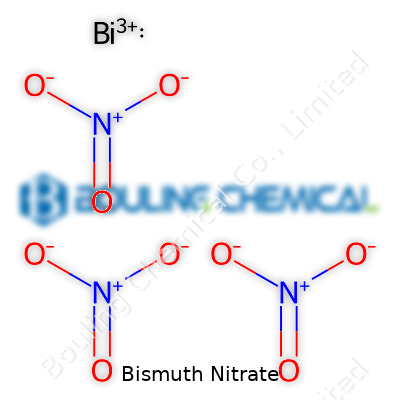
Bismuth nitrate, often identified as Bi(NO3)3•5H2O in its most familiar form, usually arrives in the lab as a white, crystalline substance. You can spot it by this chalky or powdery look, which stays consistent unless exposed to humidity, where it tends to clump and lose some flow. Not much about the name or label hints at the compound’s true versatility. Typical suppliers provide it in tightly sealed containers, making it accessible to researchers and industrial users who need a consistent supply without surprises about quality or water content.
Physical & Chemical Properties
If you’ve handled bismuth nitrate in the lab, you probably remember its distinct appearance: white and crystalline, with the powder breaking down easily between your fingers. It smells faintly acidic, hinting at the nitric acid origin. Its solubility in water isn’t legendary, but add a dash of acid, and it goes in pretty cleanly. One crucial note, bismuth nitrate won’t appreciate sitting around open with moisture in the air — it tends to break down and pick up water easily, reforming as its pentahydrate. The density sits at about 2.8 g/cm³. Stability drops off above roughly 55°C, and upon heating, it gives off nitrogen oxides, which poses a hazard if you’re not in a well-ventilated lab. Unlike its metallic relatives, it carries very little risk of poisoning in moderate quantities. Chemically, the compound behaves as a typical source of Bi3+ ions, which opens up a list of downstream reactions and applications.
Technical Specifications & Labeling
Most suppliers will specify purity above 98%, with some pharmaceutical or reagent grades going even higher, pushing toward 99.9%. You often see moisture content listed, as controlling this is critical for consistent reactivity. Labels often mark hazards relating to oxidizing activity: keep away from organic matter, and don’t let spills contact combustibles. Standard labeling also uses UN codes for oxidizer and irritant status, in addition to region-specific GHS pictograms. Lot numbers, production dates, and expiration dates are almost always noted for traceability.
Preparation Method
The industry usually produces bismuth nitrate by dissolving metallic bismuth or bismuth oxide in nitric acid. The process generates heat and a lot of orange fumes as nitrogen dioxide wafts off. Sometimes, a secondary purification step helps strip out residual lead or trace tin, reflecting the historic contamination issues that plagued bismuth sources. On the small scale, this preparation remains pretty straightforward, though the strong fumes mean you really need a fume hood and good personal protective gear. The final step often involves careful crystallization and rapid sealing of the product to preserve its hydration state and discourage breakdown.
Chemical Reactions & Modifications
Bismuth nitrate reacts actively with reducing agents and organic substrates, releasing NOx gases in even mildly energetic environments. In the realm of organic synthesis, it comes in handy as a catalyst for nitration, oxidation, and various rearrangement reactions. Reacting with water, the nitrate releases bismuth subnitrate, a less soluble form historically preferred as a white pigment and a minor medicinal. Add some chloride, and you’ll see a cloud of BiOCl form, giving a common qualitative test for bismuth. It also serves as a starting point for making other bismuth salts, simply by swapping the nitrate for another anion under acidic conditions.
Synonyms & Product Names
Many labs refer to bismuth nitrate as bismuth(III) nitrate, bismuth nitrate pentahydrate, or simply BiN. Pharmaceutical circles recognize it as a precursor for some antacids and astringents. Trade names sometimes skip the “pentahydrate” tag, but if you’re buying for scientific work, always check for the “5H2O” suffix to ensure you’re getting consistent, expected results.
Safety & Operational Standards
Handling bismuth nitrate takes discipline. It can irritate the skin and respiratory tract. Goggles, gloves, and a fume hood never feel excessive. Avoid inhaling any dust or vapor, keeping in mind that the nitrates will oxidize many organic materials, so store them far from anything flammable. Spills, especially when wet, can create slippery surfaces and mild acid hazards. Disposal runs under standard protocols for heavy metal salts: dilute with water, neutralize with alkali, and hand off to hazardous waste handlers. Prolonged skin exposure sometimes leads to mild dermatitis, and accidental ingestion should get immediate medical assessment.
Application Area
Industrial and research applications for bismuth nitrate run broad. Lab chemists often use it for synthesizing other specialty bismuth compounds. Pharmaceutical manufacturers draw on its ready solubility for preparing antacid bases and some topical astringents. Artists have turned to bismuth nitrate-derived pigments to replace more toxic lead-based paints. In electronics, it has been tested for use in ceramic capacitors and as a catalyst in specialty glass. Analytical chemists exploit its precipitation reactions to identify trace bismuth and sometimes lead in complex ores or alloys.
Research & Development
Renewed interest in bismuth compounds comes in large part thanks to the push for “green” chemistry. Researchers keep scouting for catalysts that replace more dangerous or polluting metals. Bismuth nitrate handles many oxidation reactions that transition metals usually run. Labs worldwide have published studies documenting successes in mild, scalable oxidative coupling reactions, reducing reliance on chromium or vanadium salts. Innovative work in the field of materials science explores thin films made via bismuth nitrate for high-performance sensors and new types of solar cells. Researchers also view it as a possible intermediate step in forming mixed-metal oxides with unique magnetic or electrical properties.
Toxicity Research
Unlike its neighbors in the periodic table, bismuth nitrate shows relatively low inherent toxicity when compared with lead or cadmium salts. Recent toxicological studies suggest acute exposures produce mild gastrointestinal irritation and some kidney burden at higher doses, but chronic exposure risks remain less well-characterized. Animal studies point toward a low rate of bioaccumulation, but there’s a responsible hesitancy among scientists and regulatory agencies about declaring it universally safe for all uses, especially as new applications push cumulative human or environmental exposure higher. Researchers recommend further study on the subtle effects of long-term, low-level exposure, particularly in occupational settings.
Future Prospects
Bismuth nitrate’s profile keeps rising, thanks to its balance of performance, lower toxicity, and functional utility across chemistry and industry. If regulations keep steering industry away from lead, cadmium, and chromium, there’s a strong chance that bismuth nitrate and its cousins fill those gaps with less environmental baggage. That offers researchers and manufacturers hope for more sustainable chemical processes and greener industrial practices, especially as interest in functional ceramics, catalysts, and novel drug formulations picks up. The next decade will likely bring sharper focus on optimizing both synthesis and downstream processes to minimize waste, boost safety, and get more out of each kilogram produced.
Understanding Its Role in the Chemical World
Most people probably never cross paths with bismuth nitrate unless they work in a laboratory or chemical plant. For anyone curious, bismuth nitrate comes as a pale, crystalline powder, made when bismuth metal meets concentrated nitric acid. This compound does more than just fill a spot on the periodic table. In my years around university research and the occasional industrial visit, I’ve seen how bismuth nitrate fits into projects that touch far more lives than we might guess.
Making Better Medicines
Bismuth nitrate carries a gentle touch compared to some other heavy metal salts, which makes it valuable in drug research. Pharmaceutical scientists often pick bismuth compounds because they’re less toxic for people. The best-known example might be bismuth subsalicylate, the pink stuff in many stomach remedies, which comes from a chemical path starting with bismuth nitrate. Chemists use it as a starting point because it dissolves well and reacts in predictable ways, giving them control over the medicine-making process. Reliable sources, like the U.S. National Institutes of Health, continue to support research into safer, bismuth-based drugs.
A Green Option for Organic Reactions
Back in graduate school, I watched researchers compare bismuth nitrate to more dangerous acids or metal salts. They found its reactivity but also noticed that it left behind less toxic waste. This got more attention as scientists looked for “greener” chemistry methods, meaning safer for workers, communities, and the earth. Organic chemists use bismuth nitrate as a catalyst. For instance, it helps transform alcohols into aldehydes or ketones, steps you need when building complex drug molecules or plastics. The Royal Society of Chemistry highlights how this compound gives scientists a way to create new materials without as much environmental risk.
Color in Ceramics and Glass
Bismuth nitrate adds value outside the lab, too. Glass artists and ceramic makers include it to get colors or specific textures. My aunt ran a small pottery studio and often ordered bismuth nitrate to glaze the insides of cups and bowls, because it brings glossy, pearly effects that stand out without leaching toxins. Historical records from art supply catalogs suggest that European artisans have reached for bismuth-based glazes since the nineteenth century.
Analyzing Heavy Metals
Water-quality labs keep bismuth nitrate on hand for more technical reasons. Testing for lead and other heavy metals matters, especially near old factories or mining sites. Technicians use bismuth nitrate as a reagent to help detect trace metals. Its reliability cuts down on false positives, which helps communities trust the results. According to the World Health Organization, rapid and accurate screening leads to cleaner drinking water and better public health.
Looking for Safer Solutions
Bismuth nitrate shows that chemistry isn’t only about big, abstract reactions; choices about which compounds to use have direct consequences. Shifting to less-harmful catalysts in manufacturing encourages safer working conditions and a lighter footprint on the land. Companies and labs that replace legacy materials with bismuth nitrate also reduce their hazardous waste, lowering disposal costs and risks. Safer supply chains come down to thoughtful selections like this one.
Final Thoughts
Nobody is stocking bismuth nitrate in the kitchen pantry, but the ripple effects from this compound reach into healthcare, manufacturing, art, and environmental testing. Relying on proven sources and promoting research into better, safer chemicals pays off in the long run. The story of bismuth nitrate offers a reason to pay closer attention to the ingredients—both visible and hidden—in many corners of modern life.
Understanding Bismuth Nitrate’s Solubility
Bismuth nitrate, with its classic formula Bi(NO3)3, sometimes grabs the attention of students and researchers working in inorganic chemistry. Many might think, “Hey, it’s a nitrate, so it should dissolve in water just like potassium nitrate or sodium nitrate.” Things aren’t always that straightforward.
What Experience Teaches Us
I remember early chemistry lab sessions where the instructor encouraged us to test “simple” salt solubility rules. After watching potassium nitrates vanish in water, we tried bismuth nitrate with the same expectations and got surprises. Bismuth nitrate can dissolve in water, but the process kicks up some peculiarities. Cold water works, but use too much or let the temperature swing, and you might see a white, cloudy precipitate drift out—bismuth oxynitrate, not the bismuth nitrate we began with. Anyone who’s spilled a bottle and tried to clean it up learns it isn’t as cooperative as its cousins.
Why You Should Care
Some labs and industrial processes need reliable solutions. For instance, in qualitative analysis, bismuth nitrate sometimes acts as a reagent, or finds a home in the manufacturing of pigments and catalysts. If water turns your compound into something else, results can go sideways. Even hobbyists or teachers with old chemistry sets feel the frustration. The underlying chemistry isn’t just a classroom curiosity. The nitrate does start to dissolve, but bismuth’s tendency to hydrolyze means adding a drop to pure water can produce bismuth oxynitrate—a substance with very different uses and properties. In short, you think you’re adding one thing to a solution, only to discover after some time you’ve ended up with quite another.
What Makes Bismuth Nitrate Tricky
Chemically, the bismuth ion tends to react with water itself, especially when the solution isn’t acidic. The reaction nudges the bismuth out of solution, forming an insoluble white crust. That shocks the unprepared. Instead of a clear, reliable solution, you wind up with floating solids. The solubility drops as bismuth oxynitrate forms, especially if any base sneaks in or if you use warm water. The chemistry here can catch even seasoned hands off guard, calling for precise handling.
Practical Strategies for Reliable Solutions
Practical workarounds help avoid disappointment. Acids like nitric acid hold the key to keeping bismuth nitrate happy in water. Even a weak acid can make a difference. By adding just a small amount of acid, the solution remains stable, keeping the metal ions from reacting with water and dropping out. Good labs always stock nitric acid when they work with this salt, and they approach the mixing process in a fume hood with gloves, given the compound’s toxicity. For anyone working with younger students, it’s safer to avoid using bismuth nitrate entirely or to keep the acidified solutions clearly labeled and secured.
Lessons and Implications
The story of bismuth nitrate isn’t just about textbook chemistry. It’s a warning sign on the value of testing assumptions and knowing your materials. Even if experience tells us that most nitrates dissolve freely in water, exceptions like this shape real-world practices. Behind every bottle, there’s a little more history and chemistry than first meets the eye.
The Chemical Foundation
Bismuth nitrate stands out in the chemistry world for its clear properties and formula: Bi(NO3)3. This tells us each bismuth atom pairs with three nitrate groups, shaping both how it reacts and what it can do. Many science classrooms line their shelves with bottles sporting that label. During high school chemistry, I watched a simple salt turn into something spectacular, because as soon as bismuth nitrate hits water, it gets to work, dissolving and sometimes even putting on a bit of a show as it hydrolyzes.
Why It Matters
Bismuth on its own rarely draws much attention. Often overshadowed by its neighbors like lead or antimony, it manages to carve out a role as the “safer heavy metal.” When paired with nitrate, bismuth steps forward with a solution for several old problems in industry and research. You can credit its use in pharmaceuticals and cosmetics to this very formula. Over-the-counter stomach remedies would look different without bismuth’s unique ability to curb digestive upset, though the nitrate version stays behind the counter due to its sensitivity and reactive nature.
Risks and Challenges
Opening a jar of bismuth nitrate, you notice it flakes a bit, shedding white crystals. The same property that helps it dissolve so well means it reacts quickly with moisture in the air. Storing it demands a dry spot and a tight lid; otherwise, you run into yellow stains and more complex bismuth compounds that no longer behave the way you need. Improper disposal risks nitrogen pollution and heavy metal runoff, reminding us that a useful chemical can create headaches for both water treatment plants and neighborhood streams.
Grounded Solutions and Safer Practices
Addressing these challenges starts with chemistry basics—don’t toss it down the drain. Even small labs put protocols in place. Dilute solutions settle in labeled containers while solid waste heads to hazardous material bins. Researchers support these habits with factual results: regions that treat bismuth waste carefully report lower environmental bismuth levels, which matters for both public health and local wildlife.
On the industrial side, better engineering controls keep bismuth nitrate from escaping into air or water. Closed systems and scrubbers stop nitrate dust in its tracks long before it leaves the building. Past work in electroplating factories taught me that good ventilation and a thoughtful waste stream plan quiet the alarms and keep regulators off your back.
Looking Forward
The science around bismuth nitrate keeps evolving. Newer studies show it could help in synthesizing smarter materials—especially those used in environmental cleanup or electronics. More research could yield safer substitutes or improved recycling techniques, keeping demand for mined bismuth a bit lower and cutting down on waste.
The value of knowing a formula like Bi(NO3)3 isn’t just academic. Each bottle carries potential, good or bad, depending on what we do with it. Whether labeling samples on a bench, teaching students, or setting up safeguards in a factory, a little understanding ripples far—starting from a simple formula and echoing through science, safety, and daily life.
The Straightforward Facts About Bismuth Nitrate
Bismuth nitrate calls for more respect than you might expect from something that looks like a bag of powder. This chemical shows up in academic labs, industrial applications, and sometimes even in specific research projects. Without careful storage, the risks jump up fast. I've handled similar reagents before, and a little laxity with chemicals like this will always come back to bite you. Proper storage isn’t about following pointless regulations; it’s about keeping people healthy, preventing property damage, and stretching your lab budget by avoiding needless waste.
Why Storage Conditions Matter
With bismuth nitrate, moisture creates trouble. The compound breaks down in humid air, forming nitric acid—a corrosive, dangerous byproduct. Humid environments practically invite bottle corrosion and shelf contamination. I’ve seen glassware nearly fused together when someone left a nitrate salt uncapped in a damp storeroom. Keep the lid tight, and you dodge a cleanup nightmare.
Temperature swings cause similar headaches. Steady, cool temperatures keep oxidation in check and guard against dangerous pressure buildup. Forgetting this creates scenarios where a bottle pressurizes and pops without warning. That not only puts you at risk but turns a shelf of reagents into hazardous debris.
Putting Safety Above Shortcuts
Bismuth nitrate must always stay locked inside a sturdy, chemical-resistant container. Anything less, and you risk an accidental spill or dust exposure. In my early graduate days, I once had to clean up after a plastic screw cap failed. Even a small amount sprinkled onto your hand can cause skin trouble, and inhaling the dust sometimes leads to nasty respiratory symptoms. Don’t find out the hard way—always transfer and weigh it out under a fume hood, no matter how busy you get.
Label this compound with the kind of detail you’d hope someone else uses if you have to clean up their mess. Write the date received, the chemical formula, and hazard warnings clearly. That speeds up emergency response and avoids confusion when you’re rushing through a complicated procedure. Supervisors and inspectors always appreciate extra care in record-keeping, and it keeps everyone honest. There’s no shame in documenting storage details. In fact, real transparency earns trust and keeps operations running smoothly.
Fixing the Weak Spots in Chemical Storage
Many labs and storerooms cut corners with ventilation. Bismuth nitrate isn’t especially volatile, but vented storage ensures any developing fumes won't linger and create long-term health risks. Storing bottles off the floor protects them from accidental water exposure, floods, or random leaks, which sometimes come from the least-expected sources. Keep an eye out for inventory creep—old chemical stock drifting past expiration. Safe facilities set reminders or routine checks to dispose of aging stocks. Getting rid of expired nitrate compounds cuts down on accident odds.
Quick-fire training refreshers every year help keep safety on everyone’s mind. No need for lengthy lectures—just a reminder that even everyday chemicals can cause emergencies if forgotten or misused. If your lab or workplace stores bismuth nitrate, a simple sign near the storage area listing reminder points about hydration sensitivity, ventilation, and wearing protective gloves does wonders. Too many accidents come from assumed knowledge or forgotten protocols. Bring up storage safety at regular team meetings. Address gaps and listen to feedback. People most often mishandle chemicals when they don’t feel ownership over the process—bring them in, and watch your risk drop.
Understanding What You’re Handling
Bismuth nitrate shows up in more places than you’d think. Artists and folks in labs see it on shelves, set aside with other chemical bottles. To the eye, it’s a white powder—almost harmless in appearance. Dig a little deeper, and you find a compound that quietly demands respect. Bismuth itself tends to be seen as “less toxic” than heavy metals like lead or mercury, mostly because it leaves the body much faster. Still, that phrase doesn’t mean safe for all uses or exposures.
Real-Life Experiences With Chemical Handling
On my first day working in an industrial chemistry lab, I asked about personal protection for handling bismuth salts. The answer: gloves, glasses, and a lab coat, even with substances branded as “low-toxicity.” Experience taught me that frequent, repeated exposure, even to chemicals the label calls “low risk,” starts to add up. Bismuth nitrate, like most metal nitrates, irritates skin, eyes, and the respiratory tract. Accidental splashes sting, but even the powder drifting in the air can make your nose burn and your throat feel scratchy.
Fact-Checking the Hazards
Peer-reviewed case studies mostly show mild hazards for bismuth compounds, including bismuth nitrate. The dust can wheeze its way into your lungs if inhaled. Swallowing more than trace amounts sets off nausea and can trip up your kidneys, mainly because of the nitrate. The compound reacts strongly with reducing agents and organic material, so fires and explosions are possible in accident scenarios. That matters for storage and disposal, not just lab work. Guidance from chemical safety boards points out that heat, flame, or even sunlight can break down bismuth nitrate and push it to form toxic nitrogen oxides—so good ventilation isn’t just a formality.
Environmental Impact and Broader Risks
Leftover bismuth salts rarely grab headlines, but when poured down drains or tossed as solid waste, they stick around. Studies show that if bismuth nitrate enters waterways, it can build up in soils near discharge zones. Wildlife—especially aquatic animals—sometimes winds up saddled with the compound, leading to disruption of local ecosystems. Water treatment facilities aren’t perfect at catching every trace of these compounds.
Safe Practice Can Make a Difference
Professional guidelines recommend wearing gloves, goggles, and working under a vented hood. From my experience, disposal practices can make or break lab safety. Pouring bismuth nitrate solutions into designated waste containers, labeling the waste, and following local hazardous waste pickup protocols prevents environmental headaches down the line. In schools and art studios, training people new to chemicals matters more than a warning label alone. Spills need a proper cleanup—using damp paper, gloves, and a closed bin, not a dry sweep.
Where Improvements Start
Education stands out as the main line of defense. If schools, art studios, and hobby labs made chemical hazard awareness a regular topic, far fewer accidents would crop up. Marking containers clearly, posting instructions by sinks and storage cupboards, and backing up rules with practical demonstrations can go far. It surprises some people to learn that “less toxic” in chemistry still calls for careful handling and discipline. By paying proper attention, we avoid both the short-term stings and the long-term risks that don’t show up until years after the bottle’s gone.